


Developing a multifamily property requires more than purchasing land, securing construction financing, and building apartments. A successful project also depends on how the developer organizes the capital needed to complete construction, manage expenses, and transition the property into long-term operations or a sale.
This financial arrangement is known as the capital structure.
For multifamily developers, capital structure analysis involves evaluating how different sources of debt and equity work together to fund a project. It also requires understanding the costs, obligations, risks, and repayment expectations associated with each financing source.
A development project may appear financially attractive based on projected rental income and property value. However, an unsuitable capital structure can create funding shortages, increase financing expenses, or complicate the project’s exit strategy.
Understanding the relationship between construction financing, investor equity, project costs, and permanent financing helps developers make more informed decisions before committing to a transaction.
Understanding the Capital Structure of a Multifamily Development
Debt is borrowed capital that must be repaid according to agreed financing terms. Equity is capital contributed by developers, sponsors, or outside investors in exchange for ownership interests or other negotiated economic rights.
A typical multifamily development may require financing for several stages:
- Land or property acquisition
- Predevelopment planning and approvals
- Construction and improvements
- Financing and carrying costs
- Leasing and property stabilization
- Permanent refinancing or property sale
Each stage creates financial obligations that must be considered when developing the capital structure.
For example, a developer may secure construction financing to support building expenses while using sponsor equity to cover acquisition costs and early development activities.
Once the building is completed and generating rental income, the developer may seek permanent financing to repay the construction debt.
The capital structure must support these transitions without creating an avoidable funding shortage.
Senior Construction Debt as the Foundation of Development Financing
Senior construction financing is often a major component of a multifamily development capital stack.
This financing is generally secured by the development property and may provide funds for eligible construction expenses and other approved project costs.
Construction financing differs from permanent property financing because it is structured around a development process rather than an already stabilized income-producing property.
Financing evaluations may consider:
- Total development cost
- Land acquisition and property value
- Construction budget
- Development experience
- Borrower financial capacity
- Project feasibility
- Construction schedule
- Proposed repayment strategy
Construction financing may also involve staged funding as construction progresses.
This means developers must understand when financing proceeds are expected to become available and whether sufficient capital exists to cover expenses between disbursements.
Senior debt typically has repayment priority over subordinate debt and equity interests.
However, obtaining senior construction financing does not eliminate the need for developer equity or other capital contributions.
The amount and structure of available financing depend on the individual transaction and applicable underwriting requirements.
Developer Equity and Outside Investor Capital
Equity represents the portion of project financing provided by the developer and other investors rather than borrowed through conventional debt arrangements.
Developer and Sponsor Equity
Developer equity is capital contributed by the project sponsor.
It may include cash used for land acquisition, predevelopment expenses, or other eligible project costs.
Sponsor equity demonstrates the developer’s financial participation and helps support the project’s funding requirements.
However, developers should distinguish between equity already invested and cash available for future expenses.
For example, money spent acquiring land may represent a significant investment in the project, but it is not necessarily available to pay contractors during construction.
A capital structure analysis should identify both the amount of sponsor equity and when additional cash contributions may be required.
Outside Investor Equity
Larger multifamily developments may require equity from additional investors.
These investors contribute capital in exchange for negotiated ownership interests and financial returns.
Investor arrangements may include:
- Ownership percentages
- Preferred returns, when applicable
- Profit-sharing agreements
- Distribution priorities
- Capital contribution requirements
- Management and decision-making rights
- Exit provisions
Outside equity can reduce the amount of capital the developer must contribute personally.
However, it also affects ownership, project control, and how future profits are distributed.
Developers should evaluate these arrangements as part of the overall financing strategy rather than treating investor equity as capital without associated obligations.
Mezzanine Financing and Preferred Equity in a Multifamily Capital Stack
Some multifamily projects require additional capital beyond senior debt and common equity.
Two potential financing structures are mezzanine debt and preferred equity.
Mezzanine financing is generally subordinate debt that sits behind senior financing in the repayment structure. Its security arrangements may differ from those of a traditional mortgage.
Preferred equity is an equity investment with negotiated priority rights relative to common equity.
These structures may help address financing gaps when appropriate.
However, additional capital layers can increase financial complexity.
Developers must consider the cost of the capital, repayment or distribution obligations, required approvals, and the effect on the project’s overall economics.
The existence of a financing gap does not automatically mean mezzanine financing or preferred equity is the appropriate solution.
The full capital structure should be reviewed before introducing another financing layer.
Capital Structure Analysis of a $12 Million Multifamily Development
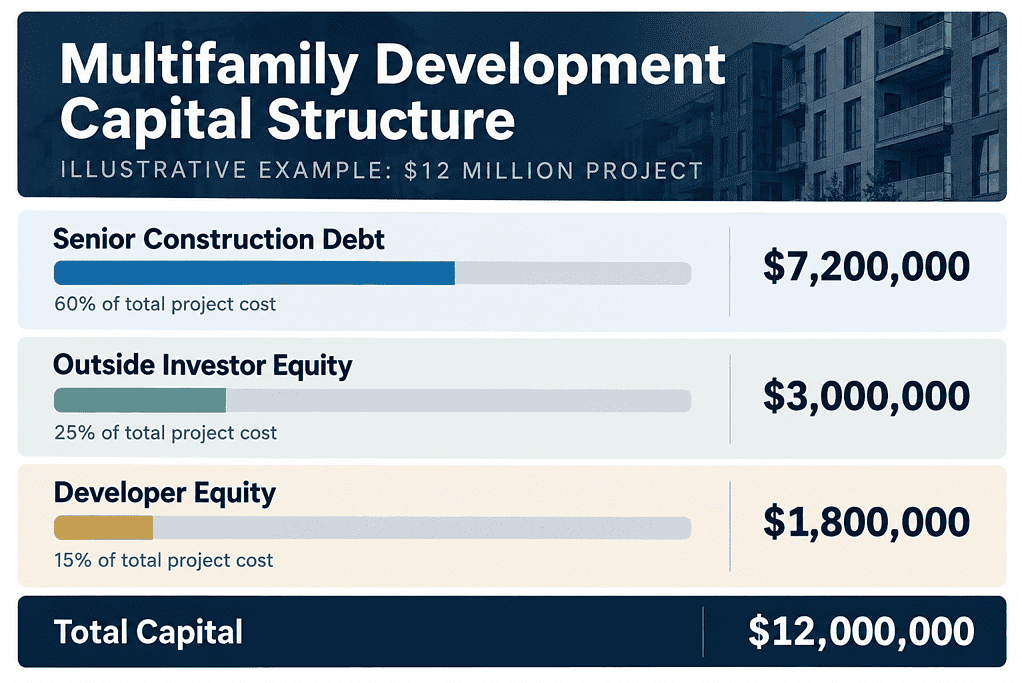
Consider a hypothetical developer planning a multifamily apartment project with a total estimated development cost of $12 million.
The budget includes land acquisition, construction, professional services, financing expenses, and contingency.
The following figures are illustrative assumptions used to explain capital structure analysis. They do not represent current lending guidelines or financing offers.
Estimated Multifamily Development Budget
| Project Expense | Estimated Cost |
|---|---|
| Land acquisition | $1,800,000 |
| Hard construction costs | $7,200,000 |
| Architecture, engineering, permits, and other soft costs | $1,200,000 |
| Financing and carrying costs | $600,000 |
| Contingency | $1,200,000 |
| Total Development Cost | $12,000,000 |
The developer must determine how to fund the full development budget.
For this example, assume the proposed capital structure includes senior construction debt, outside investor equity, and developer equity.
Proposed Multifamily Development Capital Structure
| Capital Source | Amount | Share of Project Cost |
|---|---|---|
| Senior construction debt | $7,200,000 | 60% |
| Outside investor equity | $3,000,000 | 25% |
| Developer equity | $1,800,000 | 15% |
| Total Capital | $12,000,000 | 100% |
Under this hypothetical structure, senior construction financing provides 60% of the total project capital.
Outside investors contribute 25%, while the developer provides the remaining 15%.
The capital sources collectively match the estimated project budget.
However, a balanced capital stack does not automatically mean the development is financially viable.
The developer must still evaluate financing costs, construction timing, investor obligations, property performance, and the ability to repay the debt.
How Debt and Equity Influence Development Costs and Investor Returns
Debt and equity affect multifamily development economics differently.
Debt creates repayment obligations and financing expenses.
Equity generally does not carry the same contractual repayment structure as debt, but investors may receive negotiated ownership rights and a share of project distributions.
A developer using more debt may reduce the initial equity requirement.
However, greater debt exposure can increase financial pressure if construction costs rise, project completion is delayed, or the property generates less income than projected.
Using more equity may reduce reliance on borrowed capital.
At the same time, raising additional investor equity can reduce the developer’s ownership percentage and share of future profits.
The appropriate balance depends on the project’s economics, development strategy, risk tolerance, and available financing options.
Developers should evaluate:
- Total borrowing costs
- Equity contribution requirements
- Investor distribution obligations
- Expected cash flow
- Projected return on invested capital
- Exposure to construction delays
- Refinancing or sale assumptions
A capital structure should be evaluated based on its effect on the entire transaction rather than the initial financing amount alone.
Why Construction Budgets and Contingencies Affect the Capital Structure
Construction budgets play a central role in multifamily capital planning.
A development project may encounter unexpected expenses related to materials, labor, permits, utility connections, site conditions, or project delays.
These expenses can increase the total amount of capital required.
Consider the hypothetical $12 million project.
If total project costs increase by 8%, the additional expense would equal $960,000.
The revised development cost would be $12,960,000.
This increase does not automatically mean the construction financing can be expanded.
The developer may need to use available contingency funds, contribute additional equity, revise the budget, or evaluate another financing solution.
In this example, the original development budget includes a $1.2 million contingency.
Whether that contingency is sufficient depends on the nature of the cost increase, the remaining available funds, and any other changes to the development plan.
A useful capital structure analysis should evaluate how the project performs when costs exceed the original estimates.
The Timing of Capital Contributions
The timing of capital availability is just as important as the total amount committed.
For example, a developer may have sufficient investor commitments to complete the project but still experience a temporary cash shortage if investor contributions arrive after construction payments become due.
Similarly, construction financing may require documentation or completion milestones before certain funds are disbursed.
Developers should prepare a cash flow schedule showing expected project expenses and available financing proceeds throughout construction.
This helps identify potential funding gaps before they interrupt development activity.
How Projected Rental Income Supports Permanent Financing
Many multifamily developers intend to refinance their construction debt once the property is completed and operating.
Permanent financing is generally evaluated differently from construction financing because the property is expected to generate ongoing rental income.
One important measure is net operating income, commonly called NOI.
NOI represents property operating income after operating expenses but before debt service and certain other costs.
Consider the following hypothetical operating projections for the completed multifamily property.
| Operating Measure | Annual Amount |
|---|---|
| Effective rental and other operating income | $1,050,000 |
| Operating expenses | $420,000 |
| Net Operating Income | $630,000 |
The projected annual NOI is $630,000.
This figure helps the developer evaluate the property’s income-producing potential.
However, NOI alone does not determine the amount of permanent financing available.
A refinancing evaluation may also consider property value, occupancy, debt service coverage, borrower qualifications, and applicable financing requirements.
If the property cannot support enough permanent financing to repay the construction debt, the developer may face a refinancing gap.
This risk should be considered before construction begins.
Evaluating the Property’s Stabilized Value and Refinancing Risk
A multifamily project’s expected stabilized value can significantly affect its financing strategy.
Developers often estimate property value using projected NOI and an assumed capitalization rate.
The simplified calculation is:
Estimated Property Value = Net Operating Income ÷ Capitalization Rate
Using the hypothetical NOI of $630,000 and an assumed capitalization rate of 5.5%:
$630,000 ÷ 0.055 = approximately $11.45 million
Under these assumptions, the estimated stabilized property value would be approximately $11.45 million.
That amount is below the original $12 million development cost.
This does not automatically establish whether the project is viable. However, it highlights the importance of evaluating the relationship between total development cost, stabilized income, and property value.
The capitalization rate used here is an illustrative assumption, not a statement about current market conditions.
Developers should test multiple valuation scenarios rather than relying on a single projected outcome.
How Lower Rental Income Can Affect the Exit Strategy
Suppose rental income is lower than expected because leasing takes longer or market rents are weaker than projected.
The property’s NOI may decline.
A lower NOI can reduce the property’s estimated value and affect its ability to support permanent financing.
If the resulting refinancing proceeds are insufficient to repay the construction debt, the developer may need additional capital or an alternative repayment strategy.
This is one reason capital structure analysis should include downside scenarios before development begins.
Identifying Financing Gaps Before They Become Project Problems
A financing gap occurs when the capital available to a project is insufficient to cover its funding requirements.
These gaps can arise at different stages of multifamily development.
For example, a developer may face a gap because construction costs exceed the original budget.
Another project may experience a gap because the amount of senior construction financing available is lower than initially anticipated.
A third project may complete construction successfully but discover that permanent refinancing proceeds are insufficient to repay the existing debt.
These situations require different financing responses.
Potential approaches may include:
- Additional developer equity
- New outside investor capital
- Revised development phasing
- Project budget adjustments
- Appropriate subordinate financing
- Preferred equity arrangements
- Other transaction-specific capital solutions
Each approach affects the project’s financial obligations and risk profile.
Adding more financing is not always the best solution.
Developers should evaluate how any proposed capital source affects existing financing agreements, investor rights, project cash flow, and the planned exit.
Common Capital Structure Mistakes in Multifamily Development
Building the Budget Around Unconfirmed Financing
A developer may assume a particular financing amount will be available without confirming whether the project meets the relevant underwriting requirements.
If the actual financing proceeds are lower, the project may require additional equity or a revised budget.
Underestimating Financing and Carrying Costs
Interest expenses, fees, insurance, taxes, and other carrying costs can affect the development budget.
These expenses may increase if construction or stabilization takes longer than expected.
Failing to Account for Construction Delays
Permit issues, contractor availability, material delays, and unexpected site conditions can affect completion schedules.
Delays may increase carrying costs and postpone the expected refinancing or sale.
Overlooking Investor Distribution Requirements
Outside equity may help complete the capital stack, but negotiated investor returns and distribution priorities can affect the developer’s financial outcome.
These obligations should be included in project financial modeling.
Assuming Permanent Refinancing Will Cover Construction Debt
A projected property value does not guarantee sufficient refinancing proceeds.
The developer must evaluate whether the completed property’s income, value, and financial characteristics can support the intended financing.
Focusing Only on the Initial Capital Requirement
A project may have enough funding to begin construction but insufficient liquidity to manage unexpected expenses or delays.
Capital planning should address the full development timeline.
Comparing Capital Structure Options Before Moving Forward
There is no single financing structure that works for every multifamily development.
A smaller apartment development funded primarily through sponsor equity and senior debt may have different requirements from a larger project involving multiple investors.
Similarly, a project intended for long-term ownership may require a different financing approach from one intended for sale after stabilization.
Developers should compare financing scenarios based on several factors.
Capital availability: Is sufficient funding available to cover the full development budget?
Financing costs: How will borrowing expenses and investor return requirements affect the project?
Liquidity: Will funds be available when construction and operating expenses become due?
Risk exposure: Can the project manage reasonable construction delays, cost increases, or weaker rental performance?
Exit strategy: Can the proposed refinancing or sale realistically support repayment obligations?
Ownership considerations: How will outside capital affect project control and profit distributions?
Comparing these factors helps developers determine whether a proposed capital structure supports the project’s broader investment objectives.
How Capital Structure Planning Supports Financing Execution
Capital structure analysis should begin early in the multifamily development process.
Waiting until construction deadlines approach can reduce the time available to evaluate financing alternatives.
A practical financing review should consider the project’s acquisition costs, construction budget, available equity, proposed debt, investor arrangements, development schedule, and planned exit.
It should also identify assumptions that require verification and potential risks that could affect execution.
eFunder Capital provides real estate capital strategy and financing execution for investors, property owners, developers, and appropriate commercial borrowers.
For multifamily development projects, this means evaluating how different financing components may fit together and identifying potential financing paths based on the project’s circumstances.
Rather than focusing only on an individual loan request, the objective is to understand how the financing structure supports the entire development transaction.
Build a Multifamily Capital Structure That Supports the Entire Project
A multifamily development capital structure determines how a project is funded, how financial obligations are managed, and how capital providers participate in the transaction.
Senior construction debt, developer equity, outside investor capital, and other potential financing layers each serve different purposes.
An effective capital structure should account for the development budget, financing costs, construction timeline, projected rental income, and intended exit strategy.
It should also consider what happens if costs increase, leasing takes longer than expected, or refinancing proceeds fall below projections.
The objective is not simply to obtain the highest amount of financing available.
It is to establish a practical capital structure that supports development execution while accounting for financial risks and repayment obligations.
Planning a multifamily development project?
If you need help evaluating the debt, equity, or financing gaps in your proposed development, Request a Financing Review with eFunder Capital to explore potential financing structures for your project.