

Real estate investors often reach a point where traditional mortgage financing becomes a limitation.Many conventional loans rely heavily on personal income verification, tax returns, and strict debt-to-income ratios.
These requirements can make it difficult for investors to grow a rental portfolio.
Debt Service Coverage Ratio loans, commonly called DSCR loans, were developed to address this issue.
Instead of focusing mainly on the borrower’s personal income, these loans evaluate whether the property itself generates enough income to support the loan payments.
For real estate investors and mortgage brokers working with investor clients, understanding DSCR loans is important.
This financing structure can support portfolio growth and simplify the qualification process for rental property investments.
This article explains how DSCR loans work, why investors use them, and how they fit into real estate investment financing.
eFunder Capital operates as a financing platform that helps investors and brokers structure real estate investment transactions, including DSCR loan scenarios.
What Is a DSCR Loan?
A DSCR loan is a type of real estate investment loan that qualifies based on the income produced by the property rather than the borrower’s personal income.
The key metric used in this financing is the Debt Service Coverage Ratio (DSCR). This ratio measures whether the rental income from a property is sufficient to cover the loan’s monthly debt payments.
The basic calculation is simple.
DSCR = Net Operating Income ÷ Total Debt Service
If the property generates enough income to cover the mortgage payment, the loan may qualify.
For example:
• If a property generates $2,000 in monthly rental income
• And the loan payment is $1,500 per month
The DSCR is:
$2,000 ÷ $1,500 = 1.33
A DSCR above 1.0 indicates the property generates enough income to cover the debt.
Most DSCR loan programs evaluate several factors including:
• rental income
• loan amount
• property type
• credit profile
• investor experience
Because property income is central to the underwriting process, these loans are commonly used for:
• rental properties
• small multifamily properties
• mixed use properties
• short term rental investments
DSCR loans have become an important financing option for investors who focus on income producing real estate.
Why DSCR Financing Matters
Many real estate investors eventually encounter financing constraints when trying to expand their portfolio.
Traditional mortgage lending typically requires:
• full income documentation
• tax return analysis
• debt to income limits
• employment verification
For active investors, these requirements can become restrictive. Rental income may not appear clearly on tax returns due to depreciation or other deductions.
Investors who operate multiple properties may also exceed traditional debt to income limits.
DSCR loans address these challenges by shifting the focus from the borrower’s personal finances to the performance of the property.
This approach matters for several reasons.
Portfolio Scaling
Investors who acquire multiple rental properties often use DSCR loans because qualification depends on property income rather than employment income.
This structure can make it easier for investors to add properties to a growing portfolio.
Flexible Qualification Structure
Since property income is central to underwriting, the loan process may involve fewer income verification requirements compared with conventional mortgages.
Alignment With Investor Strategy
Rental properties are designed to produce income. DSCR loans align the financing structure with the investment model.
Instead of focusing on personal earnings, the loan evaluates whether the investment itself produces sufficient income.
For brokers working with investor clients, DSCR financing can help structure deals that may not fit traditional lending guidelines.
How DSCR Loans Work
Understanding the mechanics of DSCR financing helps investors evaluate whether it fits their strategy.
The process typically involves several steps.
Step 1: Property Evaluation
The first step is evaluating the property and its income potential.
This usually involves:
• property appraisal
• market rent analysis
• property condition review
• location evaluation
If the property is not already leased, a market rent estimate is typically used to evaluate potential income.
Step 2: Rental Income Analysis
The projected or existing rental income is then used to calculate the debt service coverage ratio.
Example inputs may include:
• monthly rental income
• property taxes
• insurance
• loan payment
The goal is to determine whether the property income can reasonably support the debt obligations.
Step 3: Loan Structure
DSCR loans often involve several key parameters.
Common elements include:
• loan to value ratio
• interest rate structure
• amortization period
• prepayment terms
Loan to value levels may vary depending on the property type and borrower profile.
Step 4: Borrower Profile Review
Even though property income is the primary focus, borrower factors still matter.
These may include:
• credit score
• investor experience
• liquidity reserves
• ownership structure
The borrower profile helps determine the overall risk level of the transaction.
Step 5: Closing the Transaction
Once the property and borrower profile meet the program guidelines, the loan can move forward through underwriting and closing.
At this stage documentation may include:
• appraisal report
• rent roll or lease agreements
• borrower identification
• property information
eFunder Capital helps investors and brokers review deal scenarios and identify financing structures that align with the transaction details.
Example Scenario
Consider a practical example of how a DSCR loan might work for a rental property investor.
Property Type: Single family rental
Purchase Price: $320,000
Down Payment: 25%
Down Payment Amount: $80,000
Loan Amount: $240,000
Assume the following loan terms:
• Interest rate: 7.25%
• Loan term: 30 years
• Monthly principal and interest: approximately $1,637
Additional monthly costs:
• Property tax: $300
• Insurance: $150
Total monthly debt service:
$1,637 + $300 + $150 = $2,087
Now consider the rental income.
Market rent for the property is estimated at $2,600 per month.
DSCR calculation:
$2,600 ÷ $2,087 = 1.25
In this scenario, the property generates about 25 percent more income than the debt obligation.
This ratio may meet the minimum threshold used by many DSCR loan programs.
From the investor’s perspective, the financing decision is primarily tied to whether the property performs as an income producing asset.
Who This Loan Is Best For
DSCR loans are designed for specific types of real estate investors.
Understanding who benefits most from this structure can help determine when the strategy makes sense.
Rental Property Investors
Long term rental investors frequently use DSCR loans to acquire additional properties.
Since qualification is based largely on property income, these loans can support portfolio growth.
Investors With Multiple Properties
Investors who already own several properties may exceed traditional debt to income limits.
DSCR loans evaluate property income instead, which can make them more suitable for experienced investors.
Self Employed Borrowers
Entrepreneurs and self employed investors often have complex income documentation.
DSCR financing may reduce reliance on tax return income calculations.
Short Term Rental Investors
Some investors use DSCR loans to finance properties used for short term rental strategies.
In these scenarios, projected income estimates may be used to evaluate property performance.
Mortgage Brokers Serving Investor Clients
DSCR financing can provide an alternative structure for these transactions.
eFunder Capital regularly works with brokers to review investor financing scenarios and help structure appropriate solutions.
Common Mistakes Investors Make
Even though DSCR loans can be useful, investors sometimes make mistakes when using this financing structure.
Understanding these issues can help avoid problems later.
Focusing Only on Interest Rates
Many investors focus only on the interest rate when evaluating financing.
In practice, the overall capital structure often matters more.
Loan to value, prepayment terms, and property performance can have a greater impact on long term returns.
Overestimating Rental Income
Rental projections must be realistic.
If investors assume rent levels that exceed market rates, the property may not perform as expected.
This can reduce cash flow and affect the debt service ratio.
Ignoring Operating Costs
Some investors underestimate expenses such as:
• maintenance
• property management
• vacancy
• repairs
These factors affect the actual profitability of the investment.
Using the Wrong Financing Strategy
DSCR loans work best for stabilized rental properties.
In those cases, other financing structures may be more appropriate.
Lack of Capital Reserves
Rental property ownership involves ongoing expenses.
Investors who operate with minimal reserves may struggle if unexpected repairs or vacancies occur.
Maintaining adequate liquidity is an important part of long term portfolio stability.
Related Financing Strategies
DSCR loans are one part of a broader real estate financing toolkit.
Investors often combine multiple strategies as their portfolio grows.
Cash-Out Refinance
Investors may refinance a stabilized rental property to access built up equity.
This capital can then be used to acquire additional properties.
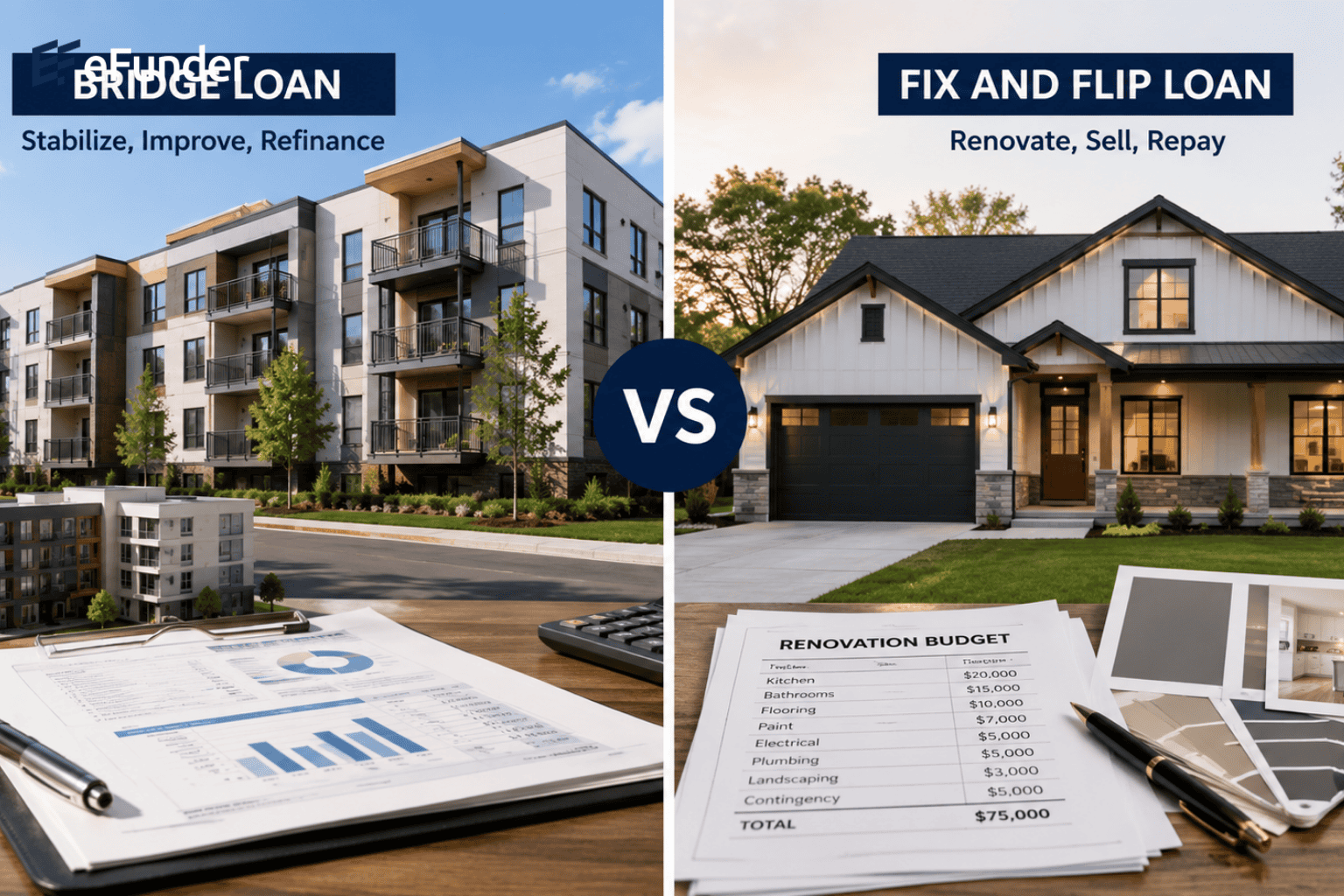
Fix and Flip Financing
Short term financing may be used to acquire and renovate properties that require improvements.
After stabilization, the property may be refinanced into a long term rental loan such as a DSCR loan.
Bridge Financing
Bridge loans can help investors acquire property quickly or stabilize assets before securing long term financing.
Portfolio Loans
Some investors prefer financing structures that allow multiple properties to be financed under a single loan.
This approach can simplify management of larger portfolios.
A financing platform like eFunder Capital helps investors evaluate which structure fits a particular transaction and investment strategy.
Final Thoughts
DSCR loans have become an important financing tool for real estate investors.
Instead of focusing mainly on personal income documentation, these loans evaluate whether the property itself generates sufficient income to support the debt.
For investors building rental portfolios, this structure aligns closely with the economics of income producing real estate.
Understanding how DSCR loans work can help investors evaluate opportunities more effectively and structure financing that supports long term portfolio growth.
Mortgage brokers who work with investor clients may also find DSCR loans useful when traditional financing options are not suitable.
If you have a deal you would like reviewed, submit it here: https://efundercapital.com/deal-intake