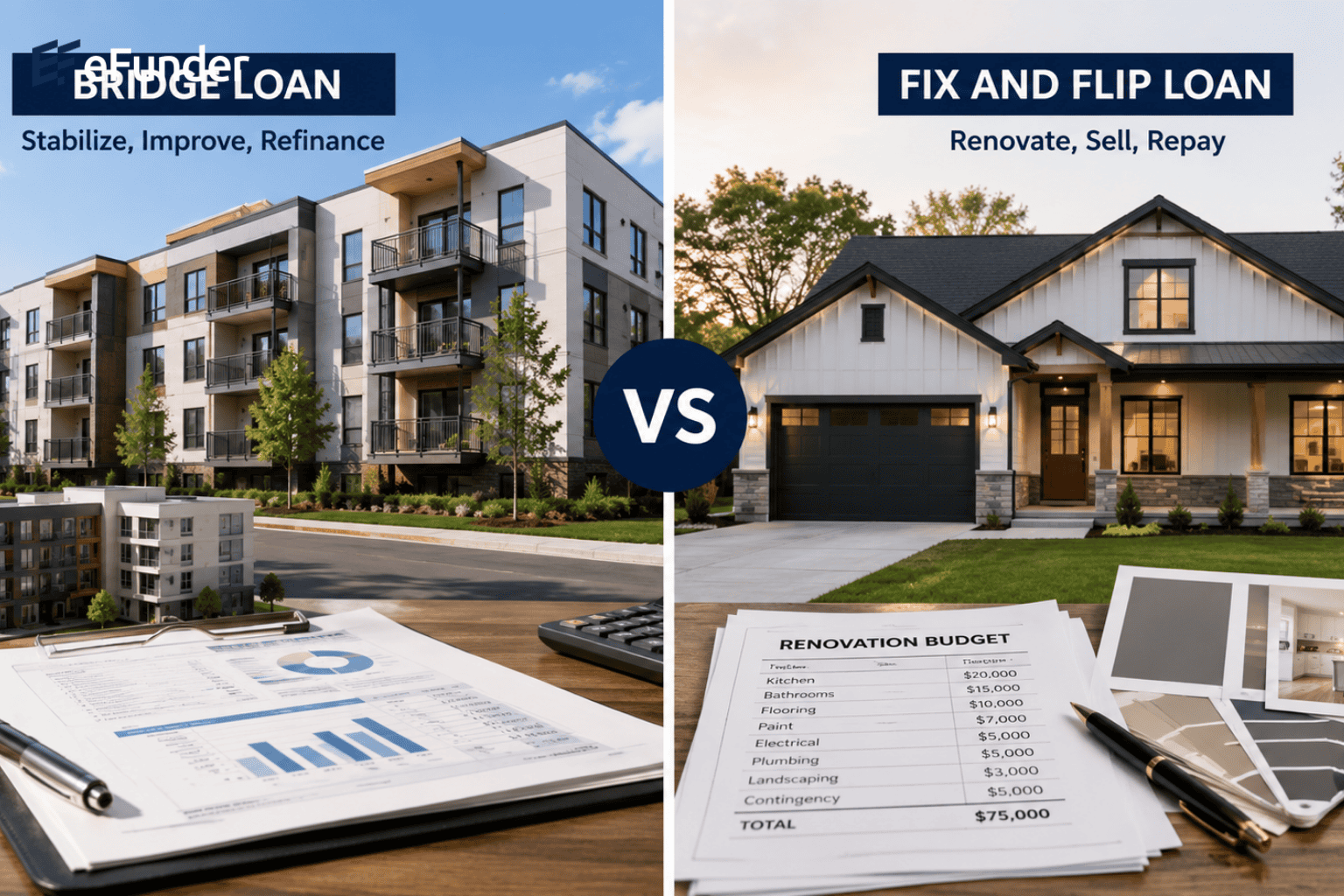


Understanding fix and flip loan requirements is one of the first steps toward financing a successful renovation project. While every transaction is evaluated individually, most financing solutions are based on a combination of the property’s characteristics, the borrower’s financial profile, the renovation plan, and the overall investment strategy.
Unlike financing for a long-term rental property, fix and flip financing is designed for short-term projects where investors purchase a property, complete renovations, and sell it for a profit or refinance into long-term financing. Because of this shorter timeline, the review process often focuses on both the current condition of the property and its expected value after improvements.
Knowing what financing providers typically evaluate before approving a project can help investors prepare stronger loan applications, avoid unnecessary delays, and identify potential issues before making an offer on a property.
Whether you are completing your first renovation or managing multiple projects each year, understanding these requirements can help you determine whether a property aligns with your financing strategy through eFunder Capital.
What Are Fix and Flip Loan Requirements?
Fix and flip loan requirements refer to the qualifications and documentation typically reviewed before financing is approved for a renovation project. These requirements help determine whether both the borrower and the investment property meet the guidelines for the requested financing.
Unlike traditional residential mortgages, which often place significant emphasis on personal income and long-term repayment ability, fix and flip financing generally evaluates the overall strength of the investment opportunity. This includes factors such as the property’s current value, estimated after repair value (ARV), renovation scope, available equity or down payment, and the investor’s planned exit strategy.
Requirements vary depending on the financing structure and the specifics of the transaction. Some projects may qualify with limited renovation work, while larger rehabilitation projects often require additional documentation, construction budgets, or borrower experience.
Preparing these items in advance can help create a smoother financing process and allow investors to move quickly when attractive opportunities become available.
Why Loan Requirements Matter for Investors
Understanding loan requirements before searching for properties allows investors to make more informed purchasing decisions. Instead of identifying a property first and hoping financing will work, experienced investors often evaluate whether a project is likely to satisfy common financing guidelines before submitting an offer.
Knowing the requirements can also improve project planning. Investors can estimate how much capital they may need for a down payment, renovation costs, closing expenses, and contingency reserves. This helps reduce unexpected funding gaps during construction.
For investors competing in fast-moving markets, preparation can also improve execution. Having financial documents, renovation estimates, and supporting information ready before identifying a property can shorten the financing timeline once a purchase agreement is in place.
Mortgage brokers also benefit from understanding these requirements. Gathering complete information before submitting a transaction often leads to a more efficient review process and fewer requests for additional documentation later in the transaction.
Common Fix and Flip Loan Requirements
Property Eligibility
The property itself is one of the first areas reviewed.
Many fix and flip projects involve single-family homes, duplexes, triplexes, four-unit residential properties, or smaller multifamily buildings that require repairs or updates. Some financing programs may also consider certain mixed-use or commercial properties depending on the project.
The property’s condition is an important consideration. Financing is commonly used for homes that need cosmetic improvements, moderate renovations, or more substantial rehabilitation before they can achieve their projected market value.
Borrower Experience
Previous renovation experience may influence how a transaction is evaluated.
Investors with a successful history of completing similar projects may demonstrate an ability to manage contractors, control renovation costs, and complete projects on schedule.
However, first-time investors are not automatically excluded from financing opportunities. In some situations, strong financial qualifications, realistic renovation plans, experienced contractors, or additional reserves may help strengthen the overall transaction.
Experience is generally reviewed alongside other aspects of the project rather than as a single qualifying factor.
Credit Profile
Credit history remains an important part of the financing review process.
While minimum credit requirements vary, financing providers often evaluate overall credit quality rather than focusing solely on a single credit score.
Items that may be reviewed include:
- Overall credit score
- Payment history
- Outstanding debt obligations
- Previous bankruptcies or foreclosures
- Recent credit inquiries
A stronger credit profile may provide additional financing options, while credit challenges may require adjustments to loan structure or additional borrower contributions.
Down Payment and Equity
Most fix and flip financing requires the investor to contribute capital toward the project.
The amount varies based on factors such as:
- Purchase price
- Property condition
- Borrower experience
- Credit profile
- Estimated renovation costs
- Overall project risk
Investors purchasing properties below market value may also benefit from existing equity in the transaction, depending on the financing structure.
Understanding the total cash required before closing helps investors avoid liquidity issues during renovation.
Loan to Value (LTV) and After Repair Value (ARV)
Loan amounts are commonly determined using one or both of these measurements.
Loan to Value (LTV) compares the requested financing to the property’s current value or purchase price.
After Repair Value (ARV) estimates the property’s expected market value once renovations have been completed.
Independent appraisals, comparable sales, renovation plans, and local market conditions are commonly used to estimate ARV.
Because future value plays an important role in many fix and flip transactions, realistic renovation budgets and accurate repair estimates are essential.
Renovation Plan and Budget
A detailed renovation plan helps demonstrate how the investor intends to improve the property.
Typical documentation may include:
- Scope of work
- Contractor estimates
- Material costs
- Construction timeline
- Itemized renovation budget
- Planned improvements
Clear documentation allows the financing review to compare renovation costs against the anticipated increase in property value.
Projects with incomplete budgets or unrealistic cost estimates may require revisions before financing can move forward.
Exit Strategy
Every fix and flip project should have a clearly defined exit strategy.
Common options include:
- Selling the completed property
- Refinancing into a long-term rental loan
- Holding the property as an investment
The selected strategy influences project timelines, expected returns, and financing structure.
A realistic exit strategy also demonstrates that the investor has considered how the loan will ultimately be repaid.
Required Documentation
Although documentation requirements vary, investors are often asked to provide information such as:
- Purchase contract
- Property details
- Government-issued identification
- Credit authorization
- Asset and bank statements
- Renovation budget
- Contractor information, when applicable
- Project timeline
Providing complete documentation early in the process can help reduce delays during underwriting.
How the Loan Review Process Typically Works
The financing process usually begins after an investor identifies a property and submits a financing request through eFunder Capital.
The transaction is then reviewed based on the property’s characteristics, requested loan amount, renovation scope, borrower qualifications, and overall investment strategy.
If the project appears to meet general financing guidelines, additional documentation may be requested to verify the information provided.
Depending on the project, the property may also require an appraisal or valuation to determine both its current value and projected after repair value.
Once all required information has been reviewed, financing terms can be evaluated based on the complete transaction rather than any single qualification factor.
Every transaction is unique, and final financing decisions remain subject to individual review based on the specifics of the property and borrower.
Example Scenario
Consider an investor who identifies a distressed single-family home listed for $250,000. After inspecting the property, the investor estimates that $50,000 in renovations will be needed to modernize the home, address deferred maintenance, and improve its market value.
Based on comparable sales in the neighborhood, the property’s estimated After Repair Value (ARV) is $380,000 once the renovations are complete.
Before moving forward, the investor prepares the documentation commonly requested during the financing review process, including:
- Signed purchase contract
- Detailed renovation budget
- Scope of work
- Contractor estimates
- Bank statements showing available funds
- Government-issued identification
- Credit authorization
The financing review evaluates several factors, including:
- The property’s current condition
- The projected ARV
- The renovation budget
- The investor’s financial profile
- The planned exit strategy
In this example, the investor plans to complete the renovations over approximately five months before listing the property for sale.
Because the renovation budget is well documented and supported by local market data, the financing review proceeds more efficiently than it would with incomplete or unrealistic estimates.
This example illustrates why preparation is important. Accurate documentation and realistic financial projections help investors present a stronger financing request while reducing questions during the review process.
Who This Financing Strategy Fits
Fix and flip financing can support a wide range of investment strategies, but it is not the right solution for every project. Understanding who this type of financing is designed for can help investors determine whether it aligns with their objectives.
Investors Purchasing Properties That Need Renovation
Many investors target properties that require repairs before they can be sold or rented at their full market potential.
Rather than paying cash for both the purchase and renovation costs, financing may allow investors to preserve capital while completing the improvements needed to increase the property’s value.
This approach is commonly used for properties requiring:
- Cosmetic updates
- Kitchen and bathroom renovations
- Flooring and interior improvements
- Roofing or exterior repairs
- Moderate structural rehabilitation
Investors Planning to Sell After Renovation
Some investors purchase properties with the intention of renovating and selling them shortly after construction is complete.
For these projects, success often depends on:
- Purchasing below market value
- Managing renovation costs carefully
- Completing repairs on schedule
- Selling within the anticipated timeline
Having a clear resale strategy before purchasing the property is an important part of evaluating whether the project is financially viable.
Investors Planning to Refinance Into Long-Term Financing
Not every fix and flip project ends with a sale.
Some investors renovate a property specifically to improve its value before refinancing into a long-term investment loan and holding it as a rental property.
This strategy may allow investors to build equity while creating long-term cash flow, provided the property’s income and financing objectives support the refinance.
Experienced Real Estate Investors
Investors who regularly complete renovation projects often develop systems for evaluating properties, managing contractors, and controlling construction budgets.
Their experience can help them estimate renovation costs more accurately, anticipate project challenges, and complete renovations efficiently.
While experience may strengthen a financing request, it is only one part of the overall transaction review.
First-Time Investors
First-time investors may also pursue fix and flip financing if they have prepared thoroughly for the project.
Successful first-time investors often strengthen their applications by:
- Developing a realistic renovation budget
- Working with experienced contractors
- Maintaining adequate financial reserves
- Researching comparable property values
- Preparing a practical exit strategy
Careful planning becomes especially important when completing a first renovation project, as unexpected costs and construction delays can significantly affect profitability.
When Another Financing Strategy May Be More Appropriate
Fix and flip financing is designed for short-term renovation projects. Investors pursuing different objectives may benefit from considering other financing options.
For example:
- Investors purchasing stabilized rental properties may evaluate DSCR loans.
- Investors seeking to access equity from an existing investment property may consider a cash-out refinance.
- Investors acquiring commercial, multifamily, or mixed-use properties may require financing designed for those asset types.
Choosing financing that aligns with the property’s intended use and long-term investment strategy is often just as important as selecting the property itself.
The next section explores common mistakes investors make when preparing for fix and flip financing and how those mistakes can affect the success of a project.
Common Mistakes Investors Make
Meeting basic loan requirements does not automatically lead to a successful fix and flip project. Many investors encounter challenges because they focus on securing financing without fully preparing the project itself.
Understanding these common mistakes can help investors improve both the financing process and the overall outcome of a renovation project.
Underestimating Renovation Costs
One of the most common mistakes is creating a renovation budget that is too optimistic.
Unexpected issues such as plumbing repairs, electrical upgrades, structural problems, or permit requirements can increase project costs. If an investor has not planned for these expenses, additional capital may be needed before the project can be completed.
Obtaining detailed contractor estimates and including a contingency reserve can help reduce the impact of unforeseen costs.
Overestimating the After Repair Value
An overly aggressive ARV estimate can make a project appear more profitable than it actually is.
Property values should be supported by recent comparable sales, neighborhood trends, and realistic expectations about the finished product. Relying on unrealistic projections may lead to financing challenges or lower-than-expected returns after the property is sold.
Using conservative assumptions during the planning stage can help investors make more informed decisions.
Failing to Prepare Complete Documentation
Incomplete documentation is another frequent cause of delays.
Missing renovation budgets, unsigned purchase contracts, incomplete financial records, or unclear project timelines may require additional review before financing can proceed.
Preparing documentation before submitting a financing request helps create a more efficient process and allows questions to be addressed earlier.
Choosing the Wrong Exit Strategy
Every fix and flip project should begin with a clearly defined exit plan.
Some investors intend to sell immediately after renovations, while others plan to refinance and hold the property as a rental. Selecting an exit strategy without considering market conditions, financing options, or project timelines can create unexpected challenges later.
The financing structure should support the intended exit strategy from the beginning of the project.
Ignoring Holding Costs
Many new investors focus on purchase and renovation expenses but overlook the ongoing costs of owning the property during construction.
Holding costs may include:
- Loan payments
- Property taxes
- Insurance
- Utilities
- Maintenance
- Permit fees
- HOA dues, if applicable
If renovations take longer than expected, these expenses can significantly affect the project’s profitability.
Moving Too Quickly on a Purchase
Competitive real estate markets often encourage investors to act quickly, but purchasing a property without sufficient due diligence can increase project risk.
Reviewing contractor estimates, inspecting the property’s condition, researching neighborhood values, and understanding local market demand are important steps before committing to a purchase.
Taking time to evaluate the investment carefully often leads to better financing decisions and more realistic project expectations.
Summary
Fix and flip loan requirements are designed to evaluate both the investment property and the overall strength of the project. Rather than focusing on a single qualification, financing reviews typically consider factors such as the property’s condition, renovation budget, projected after repair value, borrower qualifications, available equity, and planned exit strategy.
Preparing these elements before applying for financing can help investors present a stronger transaction and reduce delays during the review process. Complete documentation, realistic financial projections, and careful planning also improve the likelihood of keeping a renovation project on schedule and within budget.
Whether you are completing your first renovation or expanding an established investment business, understanding how fix and flip loan requirements are commonly evaluated can help you approach each opportunity with greater confidence.
At eFunder Capital, investors and mortgage brokers can submit projects for review to determine financing options that align with the property’s goals and investment strategy.
If you have a deal you would like reviewed, submit it here: https://efundercapital.com/deal-intake